
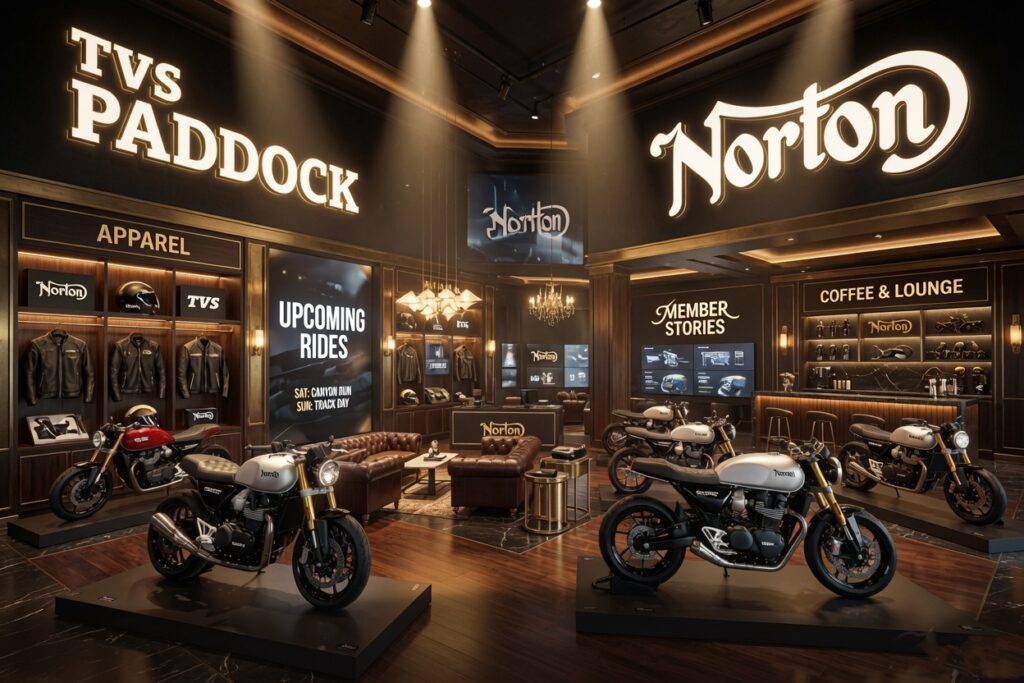
When Does a Showroom Become a Clubhouse? What TVS Paddock Really Tells Us About Indian Retail
TVS wants to sell Norton motorcycles through “immersive brand worlds.” The question is not whether India is ready for that. The question is whether Indian retail leadership is.
On June 7, TVS Motor announced TVS Paddock — a new “premium retail channel” through which it will sell its Norton motorcycles and upcoming premium vehicles, exclusively, from Q2 of FY27. The format was designed by Checkland Kindleysides, a London agency that builds what it calls culture-shaping retail experiences. The press note used the words community, experiences, merchandise, accessories, collaborations, and immersive brand worlds. It did not, you will notice, use the word showroom.
Most of the coverage has reached for the obvious comparison: this is TVS doing a Nexa. Premium channel, separate environment, better lighting, nicer coffee. That comparison is comfortable, and it is wrong or at least, it is only one-third right. So before we accept it, let us slow down and ask the three questions that actually matter.
Is this a Nexa? Does the “tribe” model, the dealership as clubhouse even work in India? And if it does, why do so many Indian leaders, the ones who sign the cheques, still treat it as a soft, unprofitable indulgence to be tolerated until the next quarterly review?
I have a strong view on all three. Let me show you the numbers first, and the opinion second.
First, what Paddock is actually copying
There are three different retail playbooks hiding inside this one announcement, and people keep mixing them up.
Playbook one: the trade-up channel. This is Nexa. Same parent, same nameplate ancestry, but a deliberately separated environment so that a customer buying a premium Maruti does not have to stand next to an Alto to do it. The genius of Nexa was never the product. It was the removal of price-anchor contamination. And it worked, spectacularly: launched in July 2015, Nexa went from roughly 5% of Maruti’s sales in its first year to around 31–32% within a decade, selling over 3.1 million units across 460-plus outlets in 280-plus cities. One in three Maruti cars now leaves through a channel that did not exist eleven years ago.
Playbook two: the host-channel disaster. This is the cautionary tale, and the TVS announcement’s own editorial commentary flagged it. In the early 2000s, Fiat sold its Uno and Linea through Tata Motors showrooms. A premium-ish product, sold through a host that did not own the relationship, died on after-sales. Bewilderment, then embarrassment, then collapse. The lesson is permanent: a brand that does not control its own floor and its own service counter does not control its own destiny.
Playbook three: the brand church. And this is the one Paddock is actually building. Norton is not a volume play. TVS bought the 122-year-old British marque out of a distress sale in 2020 for about USD 20 million, to compete with Triumph, Ducati and BMW Motorrad. You do not sell a Norton the way you sell a Jupiter scooter. You sell membership in a tribe. The clubhouse, the rides, the merchandise, the community, that is Harley-Davidson’s playbook, and it is the model the London design language in the press note is reaching for.
So Paddock is not “Nexa for bikes.” It is closer to a house-of-brands separation aimed at a tribe. Which brings us to the real question.
Does “tribe” actually work in India? The data says yes, but not the way you think
Here is where most boardroom conversations go wrong. Someone says “experience retail,” everyone pictures a glass-and-mood-lighting concept store that exists in five cities and loses money, and the CFO quietly kills it. That picture is real. It is also the wrong picture.
Because tribe, done correctly, is already the single most successful premium-retail story in India and it is not in five cities. It is everywhere.
Royal Enfield closed FY26 with 12.38 lakh units sold, up 23% year on year. For the first time in its history, it crossed one million units in the domestic market alone in a single fiscal 11.07 lakh domestic, plus 1.31 lakh exports. Its 350cc range commands roughly 94–95% of the entire 250–350cc segment. The Classic 350 by itself accounts for around 40% of all its sales.
RE did not build that by adding marble. It built it by selling belonging. The rides, the clubs, the “one life, ride hard” identity, the owner who buys the bike and then buys three jackets, four accessories, and recruits two friends. That is tribe. And it scaled across tier-2 and tier-3 India, not just the metros. So when anyone tells you Indians are “not ready” for community-led retail, point them at the company in Chennai that sells more than a lakh of belonging every single month.
Now hold that against the brand that tried to sell tribe the lazy way.
Harley-Davidson entered India in 2009 selling pure aspiration at import-duty prices. In a full decade, it sold roughly 27,000 units total, Royal Enfield was selling nearly double that every month by the end. In its final full year, Harley managed around 2,470 units. It exited in 2020, defeated by high prices, thin service reach, and a product nobody had tuned for Indian roads.
And then comes the part everyone forgets. Harley did not fail because Indians rejected the tribe. Harley failed because it priced the tribe out of reach. The moment it returned through Hero MotoCorp with the locally-built X440 at around ₹2.69 lakh, it took 25,597 bookings in a single month, two-thirds of them for the most expensive variant. Same badge. Same aspiration. Different price, different floor, different partner who actually understood the market. Demand was never the problem.
That single comparison, Harley alone versus Harley with Hero is the most important data point in this entire article. The tribe was always there. The execution was not.
The part your CFO is right about
Now, in fairness to every numbers-first leader who has ever killed a concept store: you are not wrong to be suspicious. Tribe done badly is just expensive theatre.
Even Nexa, the great success, is not a magic money printer. During the 2019 demand slump, brokerage notes flagged that many Nexa outlets were bleeding to the tune of roughly ₹1 crore a month, carrying heavier inventory than the mass Arena channel even with higher dealer incentives. A premium channel does not insulate you from a downturn. It amplifies the swing in both directions bigger upside when demand is hot, bigger pain when it is not.
So the skeptic’s instinct is correct: show me the P&L. The mistake is in believing that “tribe” and “P&L” are on opposite sides of the table.
The false choice that is quietly killing Indian experience retail
This is the heart of it, so let me be blunt.
Leadership keeps framing the decision as: experience on one side, numbers and outcomes on the other. Blend the two carefully, or pick one. That framing is the trap.
Tribe is not the alternative to a P&L. Tribe is a P&L, it is simply a lifetime-value P&L instead of a per-transaction one. The Royal Enfield owner’s value is not the bike. It is the accessories, the gear, the service retention, the second bike five years later, and the friends he brings in for free. The Nexa contribution did not show up as “vibes.” It showed up as one-in-three sales and a customer base that trades up instead of trading out.
When a leader says “I need the numbers,” the honest answer is not “trust the experience.” The honest answer is: fine, here are the numbers tribe is supposed to move. Accessory attach-rate. Service-bay retention. Repeat-purchase interval. Referral coefficient. Merchandise margin. If your clubhouse cannot move those numbers, then your skeptical CFO is right and you have built marble, not a tribe. But if it can, then you are not choosing feelings over money. You are choosing a longer compounding curve over a shorter one.
Sudarshan Venu did not bet on Paddock because he likes immersive brand worlds. TVS grew net profit at roughly 28% CAGR over five years on revenue of about ₹47,270 crore. These are not people who spend on things that do not pay. They are betting that for Norton, the lifetime-value curve beats the transaction curve. The only open question is whether they can operate it.
So what is the real constraint? It is not the consumer
Here is my actual thesis, and it will be uncomfortable for some of the people reading this.
The reason experience retail underperforms in India is not that Indian consumers are not ready. Royal Enfield disproves that at a million-plus units. The reason is that experience retail is a patience strategy, and Indian retail leadership is structurally impatient.
Tribe pays over a decade. The regional manager is on a quarterly target. The format requires the floor staff to behave like community hosts; the incentive structure pays them to behave like closers. So a company spends crores on a London-designed clubhouse, staffs it with people measured on this month’s number, and then wonders why it feels like a normal showroom with better furniture. The design was outsourced successfully. The behaviour was not.
That is the Fiat ghost in Nexa clothing. The format does not save you if the culture underneath it is still running on a per-transaction, this-quarter mindset. You cannot buy patience from a design agency.
What this means for TVS and for everyone watching
A few clear takes, since this is the part the senior leaders in this audience actually want.
On geography, stop worrying about it. “Only five to eight cities can afford it” is not a weakness of the Norton plan. It is the whole point. A racing-inspired premium motorcycle is a few-thousand-units-a-year business. Pan-India reach is irrelevant; depth in eight cities is everything. The danger only appears later, if TVS tries to stretch the Paddock format onto higher-volume premium bikes where the per-store economics break.
On blend versus push do neither. Sequence. Blending gives you a watered-down clubhouse with a sales target stapled to its forehead, and Indians smell that fakeness instantly. Instead: decide the one outcome tribe must move for Norton for a brand like this it is lifetime value and referral, not footfall, build the format ruthlessly around it, and report it in P&L language from the first month. That satisfies the outcome-obsessed leadership without compromising the outcome, because the outcome was never feelings. It was always money, just measured in years.
On the thing that will actually decide it. Not the design. Not the location. The floor culture. Whether TVS can take an organisation whose DNA is value, mass and scooters, 42 lakh vehicles a year, 45% of them scooters and run, in parallel, a small set of stores where nobody is allowed to behave like they are chasing a monthly close. That is an organisational-design problem, not a retail-design problem. It is also the one Checkland Kindleysides cannot solve for them.
Paddock is a smart bet. The model is proven, Royal Enfield proved it, Harley proved it twice, once by failing and once by succeeding. The format will be beautiful. The only question left is the oldest one in retail, the one I have watched a thousand leaders get wrong:
Can they wait long enough for it to pay?
Watch the sky. And check the file.
Disclaimer: The image is a digital render used for illustrative purposes only. This is an independent analysis and is not affiliated with, endorsed by, or connected to TVS Motor, TVS Paddock, or Checkland Kindleysides.
ABOUT THE AUTHOR
Rajalingam Rathinam
Founder of Retail Street Journal and NestOne Group. 30 years inside India’s largest retail businesses — Future Group, Landmark, Aditya Birla, Reliance, and Apple. Author of The Growth Matrix and From Clicks to Connections.
If you are a retail founder looking to build systems and scale without chaos — NestOne Group works with founders like you.
EXPLORE NESTONE GROUP →ALSO FROM RSJ
Need a laugh after all that strategy?
Read RSJ Comics — retail in 4 panels.